Geometry
When to rebuild a surface instead of simplifying it
MeshCrunch · Engineering ·
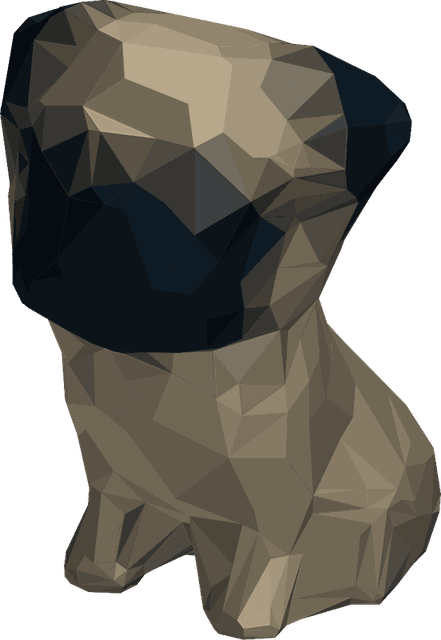
A watertight rebuild took the same 92.3 MB pug to 19,764 triangles and 387.2 KB. What that buys, what it discards, and when it is the right trade.
On this page
Simplification removes triangles from the mesh you gave it. A surface rebuild does something different: it wraps a new closed surface around the model and throws the original topology away.
The results are not comparable, and neither are the trades. On the same pug that simplified to 71,136 triangles, a rebuild returned 19,764 triangles and 387.2 KB.
What the run reported
- Triangles: 1,993,980 to 19,764.
- File size: 92.3 MB to 387.2 KB.
- Watertight: yes, which the source also happened to be.
- Every run reports how far the new surface sits from the original, so the trade is measured rather than assumed.
The rebuilt surface is a hundredth of the original triangle count, and it is a new surface rather than a subset of the old one. The reported deviation is what tells you whether that shell still resembles what you uploaded.
What it discards
A rebuilt surface shares no vertex with the original, so nothing can be carried across by identity. Materials, textures and UV coordinates do not survive, and the job records a warning saying so.
Colour is the exception, and it is resampled rather than carried. Each vertex of the new surface asks the original what colour it wears at the nearest point, and stores the answer as a vertex colour.
The transfer distance is reported for the same reason. A large one tells you the wrap skipped past a recess rather than clinging to it, and the run also warns when recesses were closed over.
When it is the right call
- Distant or background geometry, where the silhouette is all anyone sees.
- Collision and occlusion meshes, which are never rendered.
- Assets with non-manifold edges or holes, where a closed surface is the point.
- 3D printing and simulation, which need watertight input rather than a pretty one.
It is the wrong call for a hero asset, for anything textured, and for anything a customer will look at closely. Those want simplification, which keeps the surface it was given.
How tight the wrap sits
Tightness is three presets rather than a number: loose, balanced and tight. They set how closely the new surface clings, and the cost of wrapping grows quickly as it tightens.
Inside a LOD chain the same choice is positional. You name the level to rebuild from, and everything below it is rebuilt while the levels above stay decimated. Level 0 can never be rebuilt, because a chain whose top rung is not your model is not a chain of your model.
Before you ship one
The one thing to keep in mind is the thing this whole article is about. A rebuild does not return your mesh made smaller. It returns a different mesh that occupies roughly the same space.
So run it on a copy, look at the result, and check the reported deviation before it goes anywhere. On the right asset it produces something no amount of decimation can.